
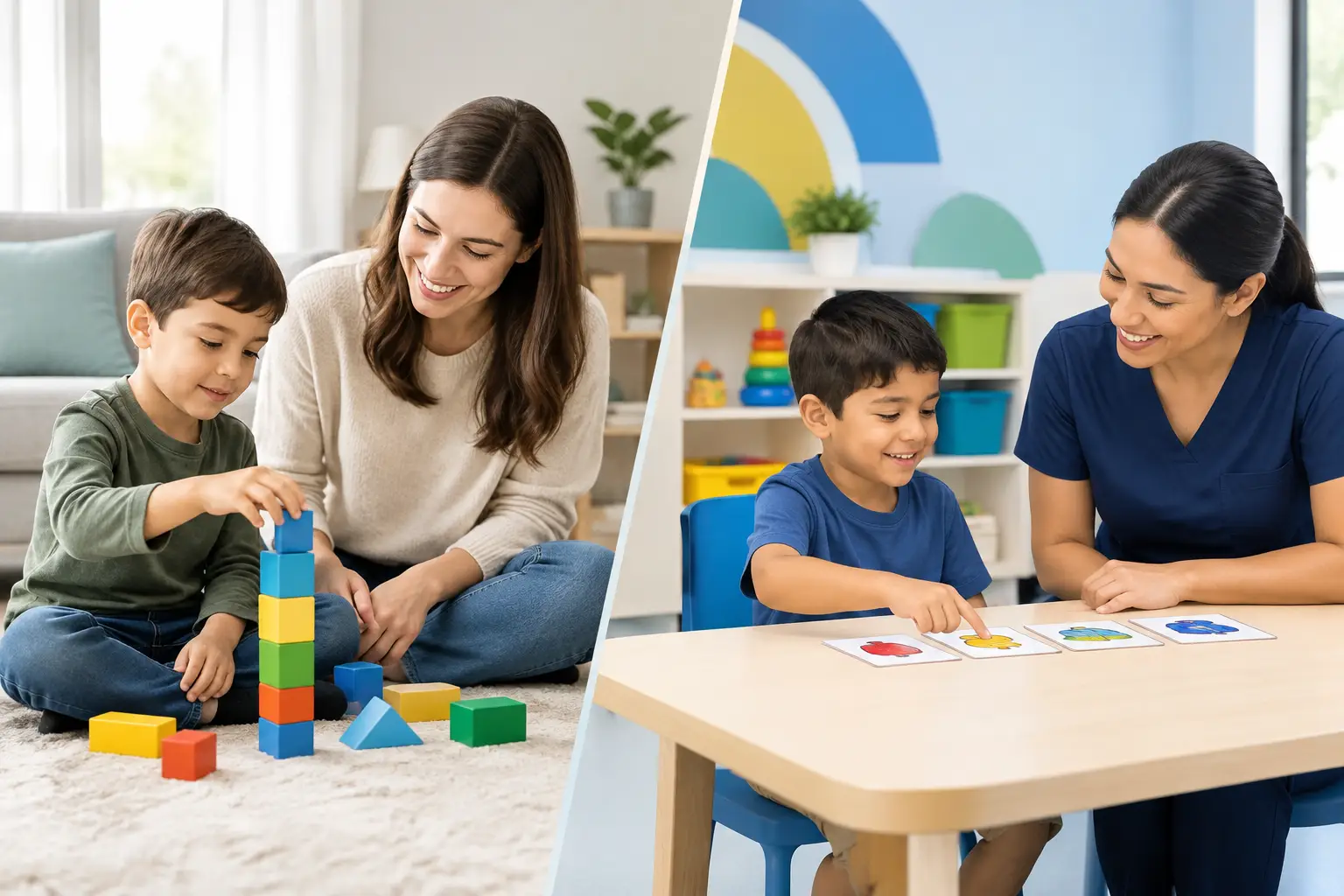
The question of in-home versus center-based ABA often comes up when a family is already carrying a lot: difficult morning routines, missed opportunities to connect, big reactions to small changes, or uncertainty about what support will actually help. Parents do not need to choose the “perfect” setting. They need a clinical plan that understands their child, fits their daily life, and builds skills that matter beyond a therapy session.
Applied Behavior Analysis, or ABA, can be provided in more than one environment because children learn in more than one environment. A child may need support asking for help at home, joining a peer activity in a structured setting, tolerating a transition at school, or completing a bedtime routine with greater independence. The best setting depends on the skills being addressed, your child’s needs, and the opportunities for practice available in everyday life.
In-Home Versus Center-Based ABA: How Settings Differ
Both in-home and center-based ABA use individualized, evidence-based strategies to support meaningful behavior change. In either setting, a qualified clinical team should begin by learning about your child’s strengths, communication style, behavior patterns, developmental needs, and family priorities. Treatment goals should be clear, measurable, and relevant to daily life.
The difference is not the quality of care a child can receive. The difference is the learning environment and the kinds of practice that environment makes possible.
What in-home ABA can offer
In-home ABA takes place where many of a child’s most important routines happen. For some families, that means working on getting dressed, sitting for meals, brushing teeth, following a visual schedule, playing with siblings, or moving from one activity to the next with less distress.
This setting can be especially valuable when challenging behaviors happen primarily at home. A therapist can observe what occurs before, during, and after a difficult moment, then help caregivers use practical strategies in real time. Instead of discussing a difficult bedtime transition in an office, the treatment team can help create a plan around the actual routine, the actual bedroom, and the actual family schedule.
In-home services also create natural opportunities for parent coaching. Caregivers can learn how to respond consistently, reinforce new skills, and make small adjustments that support progress throughout the week. This does not mean parents are expected to become therapists. It means they are given tools to feel more confident and supported in moments that matter.
There can be trade-offs. Home can be busy, with siblings, visitors, meals, chores, and limited space competing for attention. Some children may also associate home with rest and preferred activities, making it harder to participate in structured learning at certain times. A thoughtful schedule and a clear therapy area can help, but the home environment will always be real life, not a controlled clinic.
What center-based ABA can offer
Center-based ABA provides a structured environment designed for skill building. Sessions may include planned activities that support communication, play, emotional regulation, independence, learning readiness, and social interaction. For children who benefit from predictability, the center routine can make it easier to understand what is expected and practice new skills with consistency.
A center may also offer more opportunities to learn around peers. Children can practice waiting, sharing materials, joining group activities, responding to another child’s ideas, or handling small disappointments with support close by. These experiences can be helpful for children preparing for preschool, school, community programs, or other group settings.
The clinical environment can also reduce distractions that are difficult to control at home. With materials, routines, and trained staff available, a child may be able to focus more fully on goals that require repeated practice. Some children enjoy the separation between home and therapy because it gives them a distinct place to learn, play, and build confidence.
The trade-off is that a skill learned at the center may need intentional practice at home before it becomes part of a family’s routine. For example, a child may successfully use a visual schedule during a center session but still need support using one before school each morning. Strong ABA care plans for this by involving caregivers and identifying ways to carry strategies into daily life.
Choosing In-Home Versus Center-Based ABA for Your Child
The right choice is rarely based on one factor. It is usually a conversation about where your child needs support most, how they learn best, and what will allow your family to participate consistently.
In-home ABA may be a strong fit when goals are closely tied to household routines and family interactions. It can be helpful for a child who has difficulty with mealtimes, sleep routines, toileting, sibling conflict, transitions, or unsafe behaviors that occur at home. It may also be a practical choice for families who need coaching in the setting where they will use the strategies.
Center-based ABA may be a strong fit when a child benefits from routine, needs more opportunities for peer interaction, or is working toward skills that are easier to practice in a structured environment. It can support children who are building readiness for classroom expectations, cooperative play, group participation, or greater flexibility outside the home.
Your child’s age and developmental profile matter, but they do not determine the answer on their own. A young child may thrive in a center where play and communication opportunities are abundant. Another young child may make more meaningful progress at home because routines and caregiver coaching are the immediate priority. An older child may need a combination of environments to generalize skills across settings.
Practical considerations matter, too. Transportation, school schedules, caregiver availability, insurance authorization, and the family’s overall capacity can affect what is sustainable. A therapy plan only helps when it can be carried out consistently enough for your child to benefit from it. Families should never feel judged for considering what is realistic.
Many Children Benefit From Both Settings
For some children, the most effective plan is not an either-or decision. A blended approach can allow a child to practice structured learning and peer skills at a center while also working on routines and family goals at home. The treatment team can coordinate targets so the same communication tools, visual supports, and behavior strategies are used across environments.
This consistency is especially important when a child is learning a new skill. If a child learns to request a break during a center activity, caregivers can be coached to recognize and reinforce that same request at home. If a child is practicing calm-down strategies after frustration, the plan can include how those strategies will look during homework, grocery shopping, or a sibling disagreement.
Generalization is the goal. Children need more than the ability to demonstrate a skill once with one therapist. They need opportunities to use it with different people, in different places, and during the unpredictable moments of family life.
What Quality ABA Care Should Look Like in Either Setting
Whether services take place at home or in a center, families deserve care that is individualized, respectful, and clinically guided. ABA should never feel like a one-size-fits-all program. Your child’s treatment should reflect their needs, interests, communication preferences, culture, and family priorities.
A quality provider will explain why a goal matters and how progress will be measured. They will invite caregiver input, adjust strategies when something is not working, and communicate clearly about what happens during sessions. They should also focus on meaningful outcomes, such as more functional communication, greater independence, improved emotional regulation, safer behavior, and fuller participation in family and community life.
Ask how parent coaching is included, how the clinical team supervises treatment, and how skills will transfer from therapy into everyday routines. If peer interaction is a goal, ask how it will be taught. If home behavior is a concern, ask how the provider will help caregivers use strategies between sessions. Clear answers can help you feel confident that therapy is built around your child rather than a preset schedule.
At MGM Behavioral, families are treated as active partners in the process. The purpose of ABA is not simply to make a session go well. It is to give children and caregivers practical support that makes daily life more manageable, connected, and hopeful.
A consultation can help turn a broad question about setting into a clear plan for your child. When care starts with your family’s real routines, real concerns, and real goals, the next step becomes easier to see.